Fragrances today are mostly a fusion of ingredients taken from nature – or inspired by nature – together with the synthetics (man-made ingredients) that are used to make them last longer, ‘carry further’, or stay ‘true’, when worn on the skin.
Here, you can read about literally hundreds of the different perfume elements in use today. If you know which ingredient you want to read about, you can either input the name into our ‘search’ box (top right). Or click on a letter of the alphabet below – and it’ll take you to a collage of all the ingredients that start with that letter. Alternatively, let your eye travel over the scrolling, rolling collage below – and click on whatever takes your fancy: a visual ‘lucky dip’…
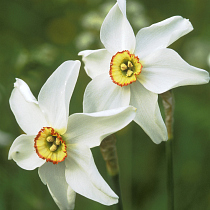
Narcissus
Rich, floral, green, heady: like burying your nose in springtime itself. Or as perfumer Julie Massé explains to The Perfume Society: 'An opulent sensation of green-leaf, or the hissing of hot, wet summer lawns - a strangely intense and yet cool floral.'
Narcissus has been exciting perfumers for millennia. The Arabs used it in perfumery, then the Romans, who created a perfume called Narcissinum with the oil from what’s become one of our favourite modern flowers. In India, meanwhile, narcissus one of the oils applied to the body before prayer, along with jasmine, sandalwood and rose. (Nobody’s quite sure where the first flowers were grown; some believe it originated in Persia, and made its way to China via the Silk Route.)
There are hundreds of different species of Narcissi today – white, yellow, some with a touch of pink or orange (including our ‘everyday’ daffodil) – but not all are fragrant. The Pheasant’s Eye Narcissus (a.k.a. Poet’s Narcissus, or Narcissus poeticus) is native to Europe, and growers cultivate it in the Netherlands and the Grasse area of France, extracting an oil which smells like a blend of jasmine and hyacinth.
The scent can also be extracted from the so-pretty ‘bunched’ variety – Narcissus tazetta – is native to southern Europe and now also grown widely across Asia, the Middle East, north Africa, northern India, China and Japan. A third variety, Narcissus jonquil, can also be used, and in one form or another this beautiful ingredient is said to make its way into as much as 10% of modern fragrances - despite the fact that a staggering 500 kilos of flowers are needed to produce a kilo of ‘concrete’, or just 300 g of absolue, making it very pricy.
It’s so powerful, though, that only a touch is needed – and perfumers must proceed with caution: the scent in a closed room can be overwhelming. (Narcissus actually gets its name from the Greek word ‘narke’, which made its way into Roman language as ‘narce’: that meant ‘to be numb’, and alludes to the effect the oil can have.)
The supposed Greek legend linked with the flower is well-known: Narcissus was a handsome youth who fell in love with his own reflection, on seeing it in a pool. Unable to leave behind the beauty of his image, Narcissus died – to be replaced by this flower…
Smell narcissus in:
Boucheron Boucheron
Creed White Flowers
Penhaligon's The Revenge of Lady Blanche
Van Cleef & Arpels First
Wales Perfumery County
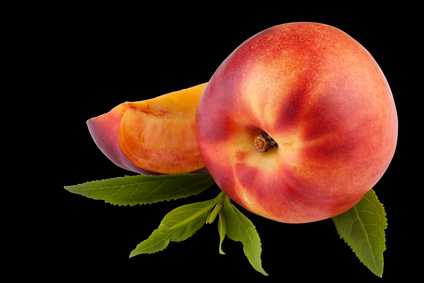
Nectarine
Sweet, juicy, peachily honey-like: nectarines have been dripping their bright fruitiness over quite a few compositions, of late, riding on the popularity of fruity-florals. (Nectarine goes particularly well with fruity notes, actually.) Can anyone who’s not a trained ‘nose’ tell the difference between this and an actual peach? Yes, if we eat it: nectarines are of course smooth-skinned, and have a whiter flesh. But in a perfume…? We’d love to hear if you can tell them apart. (Though we do also invite you to improve your sense of smell through one of our nationwide workshops for subscribers – click here for details.)
Smell nectarine in:
Penhaligon’s Artemisia
Yves Saint Laurent La Collection Yvresse

Neroli
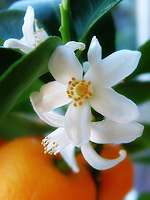 The bitter orange tree – Citrus aurantium var. amara – is one of the wonders of the fragrant world. (You might better know it as the Seville orange tree.) The leaves and twigs give us petitgrain, while the cold-pressed peel of the fruit gives us bigarade.
But it’s the orgy of white neroli blossoms which get ‘noses’ really excited: airy, citrussy, green, but with whispers of honey and orange bubbling subtly underneath. It’s extracted by steam distillation of freshly-picked flowers, which must be a gorgeous task.
The name ‘neroli’ comes from a small Italian town near Rome, and a princess who lived there. Anne Marie Orsini (also known as Anna Maria de la Tremoille, and originally French), fell in love with the scent of neroli, which fragranced the air in spring. She was the first person to distil orange flowers to make essential oil, which she used to scent her clothes, baths and gloves. (Gloves and perfumery are inextricably linked, which you can read about in our Perfume History section.) It seems to have been something of an aphrodisiac, and kickstarted a craze among the local residents for this seductive oil, which is said to have been blended with flowery sweet notes and musk.
Long before that, though, the bitter orange tree is thought to have been brought to Europe by the Arabs from the Middle East, when the trade routes opened up. Nowadays, it’s widely cultivated: orange groves flourish from North Africa to North America, France and Italy. (The best oil, though, is said to come from Tunisia, where Jean-Paul Guerlain has his own bitter orange grove…) During the distillation process, a beautifully scented water’s also produced, which makes its way into floral waters and flavourings. And if you’re ever lucky enough to find yourself standing in a grove of these trees, it’s an unbelievably delicious, sense-drenching experience.
Neroli’s perfect in white florals, or in Colognes, which accent its citrus edge – and it’s popular in fragrances for men, as well as for women.
Smell neroli in:
Goutal Neroli
Creed Orange Spice
Diptyque L’Eau de Neroli
Penhaligon’s Eau de Cologne
SokiLondon Cleopatra

Night-blooming cereus
Cereus doesn’t sound too ‘sexy’, but Queen of the Night…’? We’re half-way to falling in love with this ingredient for its exotic name, never mind the sweetly floral, vanilla-y fragrance which can be so captivating, in a perfume. This is also sometimes known as ‘The Honolulu Queen Flower’; the large, short-lived flowers of the cactus-like plant bloom for just six hours, opening in the evening and closing by dawn. Some flower just once a year, for a single night – a blink-and-you’ll-miss-it pleasure that happily can be captured in a bottle and enjoyed 24/7…
Smell night blooming cereus in: